

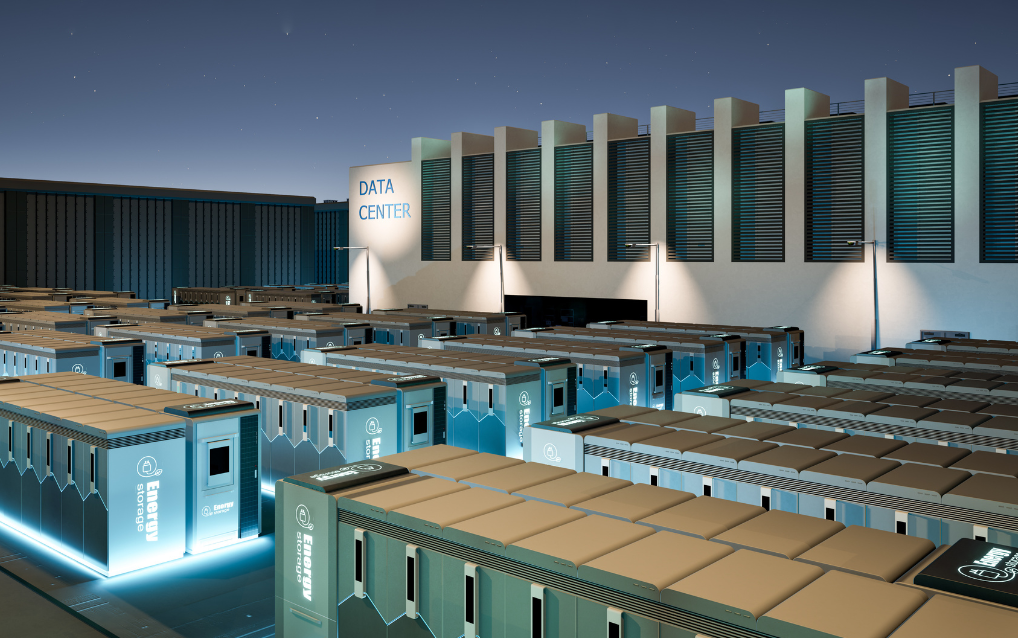
Data centers are powering the new economy. Every AI query, every streamed movie, and every cloud backup runs through one of them somewhere. Demand is climbing fast, and the capital required to build and operate these facilities is climbing right alongside it. That’s where data center financing comes in.
As the industry grows, it remains fragmented, new and unfamiliar to most lenders. This post breaks down data center funding options that do exist in spite of these challenges, what we provide, who we fund, and what you can qualify for. As you’ll see, the right answer almost always comes down to where you sit in the supply chain.
The Data Center Supply Chain, Distilled
The industry looks complicated from the outside, but it really breaks into three distinct groups. Understanding how they fit together is the key to understanding which financing options are actually available to you.
Developers are the ones who find and secure the land, then handle the ground-up construction of the facility itself. Owner operators take over from there, running the data center day to day once it’s live and generating revenue. Subcontractors handle everything else that keeps the building running. That means the power, the cooling, the cabling, the security, and dozens of other systems working behind the scenes.
We provide data center financing to two of those three groups: the owner operators and their subcontractors. Our focus is the operational side of the business, not the raw land underneath it and not the ground-up construction of the building. Once real assets are in play and revenue is on the horizon, that’s where we come in.
Data Center Financing vs. the Other Ways to Raise Capital
Once a data center reaches real scale, it has options. Most fall into one of five categories, and it helps to see the whole ladder before we zero in on ours.
The first is a YieldCo or DevCo structure. Here, the operator spins the stable, income-producing assets into a separate vehicle that pays investors a steady yield. A second path is public funding or an IPO, taking the company or its assets to the public markets. Third comes private funding or private equity, raising capital from institutional investors in exchange for ownership. A fourth option is a joint venture with a larger company, pooling resources and sharing both the risk and the reward.
Each of these can work, but they share a common trait. They’re big, slow, and usually dilutive – they cost you ownership, control, or both. And they’re only realistic once a data center is large enough to attract that kind of attention.
That’s where the fifth option comes in: commercial credit. This is the lane we operate in. Asset-based lending, equipment financing, and factoring don’t require you to give up equity or wait months for a deal to close. They scale with your business, they respect your ownership, and they’re available long before you’re ready to ring the bell at the stock exchange. For most operators and subcontractors, commercial credit is the practical answer – and the rest of this post explains how it works.
Data Center Financing for Owner Operators
Owner operators run the facility and bill the end clients directly. Those clients are often large enterprises like cloud providers or Fortune 500 companies. What an operator qualifies for depends on two factors: the credit strength of their customers, and their own profitability.
If an operator is profitable and serves large, creditworthy enterprise clients, they can usually qualify for asset-based lending, or ABL. In simple terms, ABL lets a company borrow against its receivables – the money those enterprise clients already owe them for services rendered.
If that same operator isn’t profitable yet but still serves strong enterprise clients, then factoring tends to be the better fit. Factoring works by selling those receivables at a small discount in exchange for cash today. And because it leans on the customer’s credit rather than the operator’s, it doesn’t require profitability to qualify.
For example, imagine an owner operator that bills Microsoft $2 million a month on net-60 terms. If that operator is profitable, ABL can give them a revolving credit line secured against that receivable. If they’re instead burning cash to grow quickly, factoring can advance most of that $2 million right away. That way, they aren’t left waiting a full 60 days to get paid.
Data Center Financing for Subcontractors
Subcontractors are the specialists of the data center world. They install and maintain the physical systems a facility depends on to function. There are far more of them involved than most people outside the industry realize.
The financeable functions across the supply chain include:
- Data Center Power Systems – including UPS units, backup generators, switchgear, and power distribution units that keep electricity flowing without interruption.
- Cooling Systems & HVAC – from CRAC and CRAH units to chillers and the liquid cooling systems now required for high-density server racks.
- Data Center IT Hardware – such as the server racks themselves, networking equipment, and the structured cabling that ties everything together.
- Data Center Fire & Security – covering detection systems, suppression systems & equipment, and the access controls that protect the facility.
- Data Center Monitoring – including maintaining the software platforms and ongoing service contracts that keep every one of these systems running smoothly.
For companies like these, data center financing tends to look quite different than it does for the operators. A subcontractor is usually a smaller business, and it often sells its services to just one or two data centers at a time. That concentration creates a real problem when it comes to receivables-based lending.
Funding the Whole Supply Chain
When you step back and look at the whole picture, it actually becomes fairly simple. Whether you happen to be an owner operator or a subcontractor, your data center financing options really come down to just four questions.
What assets can you offer up as collateral? How creditworthy are the customers you serve? Are you profitable today? And what debt already sits on your balance sheet ahead of any new financing? The answers to those four questions point directly to the right structure for your situation.
Profitable operators with strong enterprise clients point toward ABL. If you’re growing but not yet profitable, factoring is the fit. Subcontractors with expensive equipment – or operators equipping a facility before launch – point toward equipment financing. And when a business already carries a senior lender but needs more, subordinated debt is the answer.
That full range is exactly what allows us to operate in 360 dimensions across the data center supply chain. We fund owner operators and subcontractors alike, from the moment real equipment enters the picture through every stage of ongoing operation.
The one and only thing we don’t finance is the dirt itself, along with the ground-up construction that sits on top of it. No raw land, and no building the shell. But the moment there are real assets to secure, there is a clear path to capital. That could be equipment on order, receivables on the books, or a facility coming to life.
Why Equipment Financing Fits Data Centers
Equipment financing, on the other hand, fits these companies well. Subcontractors need expensive, long-lived assets to do their work. That might be an industrial cooling system, a backup generator, or a rack of specialized processing hardware. We finance those assets directly and use the equipment itself as the collateral. The asset does the work for the business, and that same asset secures the loan behind it.
Consider a cooling subcontractor that wins a contract to install a liquid cooling system for a new AI data center. The system carries an $800,000 price tag. Equipment financing can fund that entire purchase, with the cooling system itself standing as the collateral for the loan.
A Note on Inventory Financing
Inside a data center, what looks like “inventory” is really equipment. Anything used to process data is a long-lived asset, amortized over its useful life. It isn’t stock that turns over quickly the way retail goods do on a shelf. Because of that, traditional inventory financing simply doesn’t apply in this world. Equipment financing quietly covers that same ground instead.
The Outside Risks Every Credit Investor Should Weigh
There’s a risk to data center financing that doesn’t show up on any balance sheet. It’s the world outside the fence line, and it’s growing fast.
Data centers have become a political flashpoint. Communities are pushing back hard over water use, noise, and the strain these facilities put on the local power grid. In many towns, residents blame data centers for rising electricity bills. That anger has teeth. Across the country, dozens of projects have already been blocked, stalled, or withdrawn after local opposition.
The politics have escalated too. Some states and cities have passed moratoriums that pause new data center development entirely. Federal lawmakers have introduced bills to slow the industry down. Grid regulators are rewriting the rules for how these facilities connect to power. For a credit investor, all of this adds up to real risk – a project can be technically sound and still get derailed by a zoning board or a ballot measure.
So what does this mean for financing? It means the structure matters more than ever. A loan tied to a specific, movable asset – a generator, a cooling system, a rack of hardware – is far safer than one tied to a facility’s long-term political fortunes. Equipment financing and asset-based lending hold up well here, because the collateral has value no matter what happens to the broader project. This is exactly why we underwrite the assets and the receivables, not the headlines.
Why Junior Debt Is Often the Key
There’s one more piece worth calling out on its own, because it comes up again and again. Almost every data center already has a senior lender in place – a bank, a construction lender, or an equipment financing partner that holds a first claim on the assets.
The catch is that a senior lender rarely covers everything a growing business actually needs. Many operators need additional capital layered in behind their existing debt.
This is precisely where subordinated financing changes the entire equation. We can fund junior debt that sits behind your senior lender. It respects their first-lien position, while still delivering the additional capital your business needs to move forward. Your senior lender keeps their security intact, and you get meaningfully more runway to work with.
Picture a data center carrying a $10 million senior loan against its equipment, but needing another $3 million to expand its capacity. We can provide that $3 million as subordinated debt. It’s junior to the senior lender in priority, but funded all the same – and it doesn’t disturb the existing loan or its terms in any way.
So wherever you sit along the data center supply chain, and whatever already sits on your balance sheet, there is usually a structure that fits. If you operate or supply a data center and need capital to keep growing, we can help you find it.